
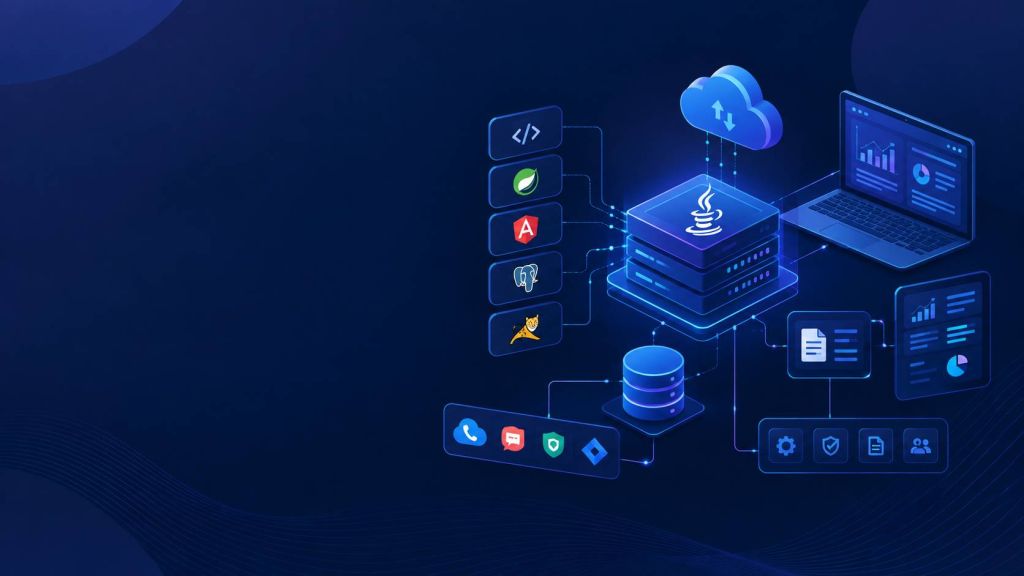
Java/J2EE: a mature, platform-independent stack for building web, mobile and enterprise applications that hold up under real production load. Here’s the stack we build on, and how the pieces fit together. We’ve been designing, building and supporting Java based systems for customers in India, the US and Canada for more than a decade — long enough to have carried applications through a full lifecycle: initial build, years of maintenance, and eventually a move onto a newer framework. That experience is less about any single project and more about a set of technologies and patterns we’re genuinely comfortable in. Here’s what that looks like in practice.
Talk to usThe frameworks we build enterprise Java on
Most of our Java work starts from a familiar shape: a Controller that takes the request, a Model that carries the business object, and a View that renders it back — classic MVC, whether it’s expressed through Struts and JSP on an older codebase or Spring MVC on a newer one. We’ve kept that pattern consistent across more than a decade of projects, which is precisely what makes it easy to hand a system between engineers, or between us and an in-house team, years after go-live. Where a project calls for more, we layer in Spring Boot for the application core, Spring Security to guard access points for both browser and web-service clients, and Spring DAO to keep the persistence layer cleanly separated from business logic. On the newest of our projects we’ve paired that backend with an Angular front end, moving the UI/UX layer out of JSP entirely while keeping the same Java service core underneath.
Getting Java systems to talk to the outside world
A good share of our Java work isn’t building something from a blank page — it’s getting an existing Java application to talk cleanly to something outside it. We’ve wired up Twilio for outbound calling and scheduled voicemail, PagerDuty for uptime and incident alerting, Jira for issue and status synchronisation, and a telecom-grade SMS/WAP consent gateway built to meet a regulator’s compliance mandate. The common thread is a thin, well-defined REST or SOAP layer that keeps the core Java application unaware of exactly which third party sits on the other end of the wire — so swapping or adding an integration later doesn’t mean touching the core.
Data, persistence & reporting
On the data side we work across PostgreSQL , MySQL and Oracle , almost always through Hibernate or JPA so the data-access layer stays a clean, swappable piece rather than logic scattered through the application. Where a project needs generated output rather than just stored data, we reach for Jasper Reports for invoice and billing documents, CKEditor for in-app report authoring, and straightforward Excel, Word and PDF export for anything that needs to leave the system in a familiar format.
Our Java Application Services
Build, integrate and modernize business-critical Java applications with experienced application development, API integration and long-term maintenance capabilities.
- Custom Java Application Development
- Enterprise Web Applications
- API & Third-Party Integrations
- Billing & Invoicing Solutions
- Monitoring & Observability Integrations
- Java Modernization
- Support & Long-Term Enhancement